On this page
The Tissot PRX Quartz and PRX Powermatic 80 share the same integrated-bracelet design but differ in three practical ways: movement (quartz accuracy and near-zero maintenance versus an 80-hour automatic with an exhibition caseback), thickness (roughly 9.6–10.4mm quartz versus 10.9–11.3mm automatic), and price (generally $375–$450 for quartz versus $650–$750 for Powermatic 80, a gap of around $300). Neither is a compromised version of the other — they're built for genuinely different priorities within the same design.
The Tissot PRX doesn't really have a "better" version between quartz and Powermatic 80 — it has two versions built around different priorities, wearing the same acclaimed case design. That's a more useful way to think about this decision than treating one as the entry model and the other as the upgrade, because plenty of PRX owners genuinely prefer the quartz on its own merits, not as a budget consolation.
This breaks down what actually changes between them, so you can match the choice to how you'll wear it rather than just to your budget.
Shared DNA: What Doesn't Change
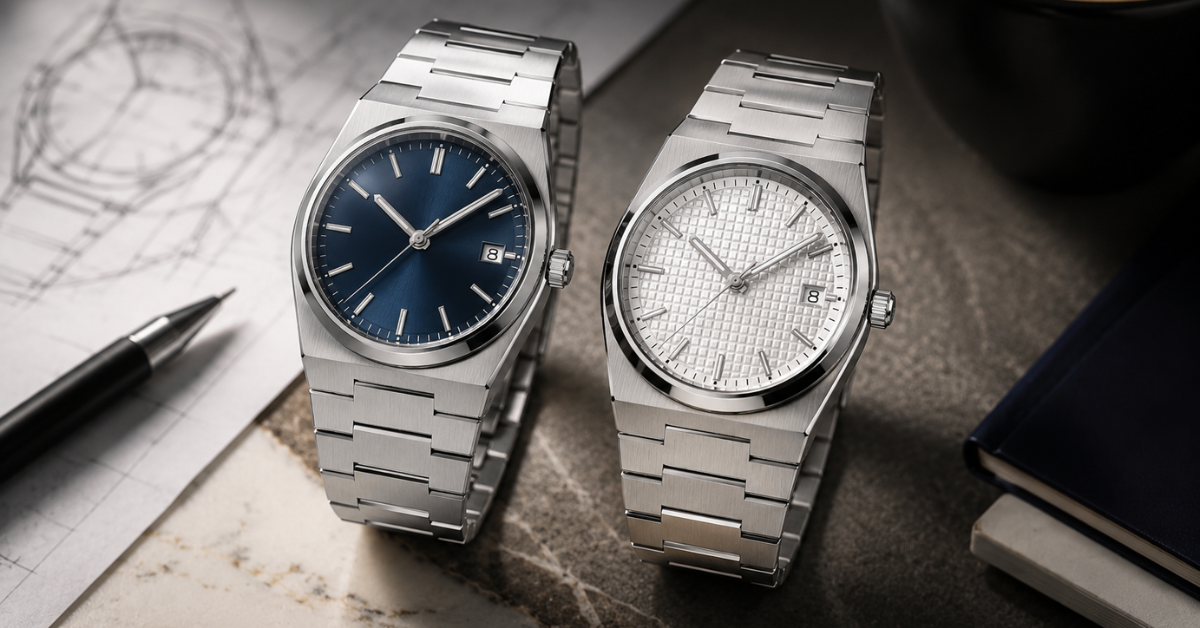
Both versions trace back to the original 1978 PRX, revived by Tissot starting in 2021 as an answer to the integrated-bracelet sport-luxury design language most associated with watches costing many times more. Both share the same distinctive cushion-shaped case, the same satin-brushed bracelet with polished interior facets, sapphire crystal, and 100 meters of water resistance. If you're comparing this line against the rest of Tissot's current pricing structure, our Tissot Price Guide covers where both versions sit relative to the wider catalog.
Movement: The Real Dividing Line
This is where the two watches actually diverge, and it shapes almost every other difference between them.
The PRX Quartz runs Tissot's ETA F06.115 movement — Swiss-made, accurate to roughly ±10 seconds per month, with a battery rated to last around a decade before needing replacement. It's a genuinely low-maintenance watch: set it, wear it, and it keeps accurate time without a second thought. The dial uses a sunburst finish, and the caseback is solid rather than an exhibition window, since there's no movement finishing underneath worth displaying.
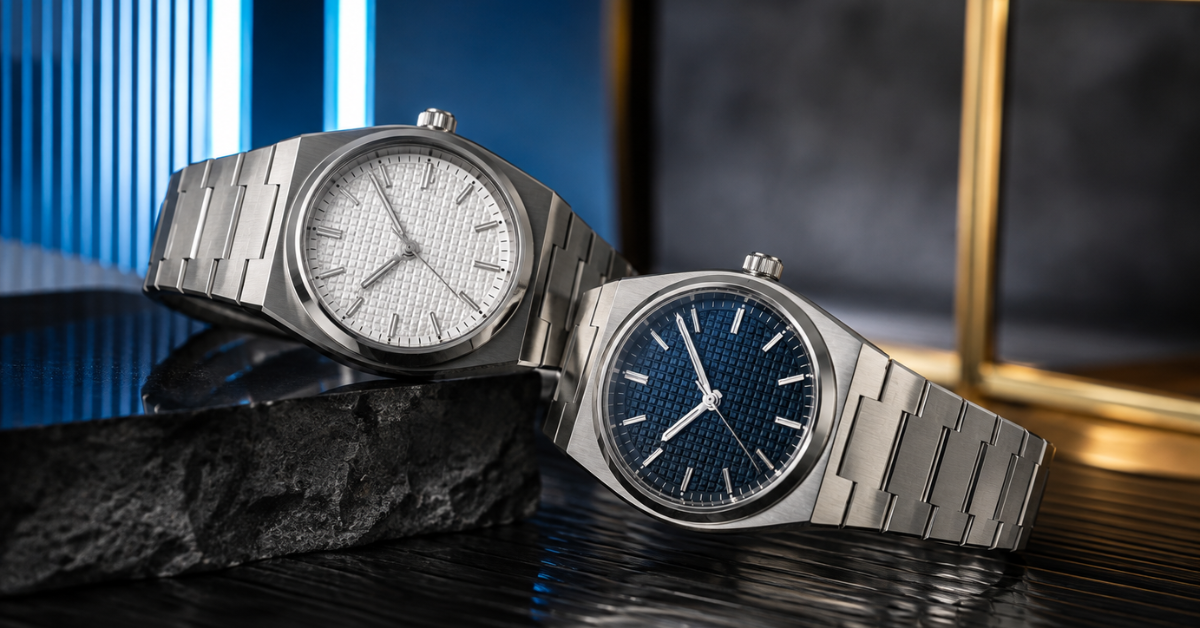
The PRX Powermatic 80 runs Tissot's Powermatic 80.111 automatic movement, offering roughly 80 hours of power reserve — long enough to sit unworn over a weekend and still be running when you pick it back up. It's visible through an exhibition caseback, and the dial carries a distinctive waffle texture that's become the visual shorthand for spotting the automatic version at a glance, replacing the quartz's sunburst finish. If a battery replacement every 2 to 5 years feels like an unwelcome chore, or you specifically want to watch a mechanical movement work, this is the version built for that.
Thickness and Case Feel
The quartz movement's compact size lets Tissot keep the PRX Quartz genuinely slim — reported thickness generally runs 9.6mm to 10.4mm depending on the specific reference, contributing to the watch's reputation for wearing exceptionally well under a cuff.
The Powermatic 80's automatic movement requires more vertical space, pushing the case to roughly 10.9mm to 11.3mm thick. That's not a dramatic jump in absolute terms, but on a watch defined partly by its slim, integrated profile, it's noticeable in hand — a slightly more substantial wrist presence that some buyers specifically want from a mechanical watch, and others find works against the PRX's original slim-case appeal.
Case Size Options
Both versions are available at 40mm, the size most associated with the PRX since its 2021 relaunch. The quartz version also comes in a 35mm option, aimed at smaller wrists or buyers who prefer a more compact daily watch.
The Powermatic 80 launched in 2023 at 40mm and 35mm as well, notably skipping the 37–38mm "in-between" size many enthusiasts had asked for. That gap closed in late 2025, when Tissot introduced 38mm Powermatic 80 references — though as of this writing, those are only available in premium case materials like titanium and Damascus steel, at a correspondingly higher price than the standard steel 40mm and 35mm options.
Price: A Real, Not Trivial, Gap
The PRX Quartz generally runs $375 to $450, while the Powermatic 80 sits at roughly $650 to $750 — a gap of around $300 for the same core design. That premium buys the automatic movement, the exhibition caseback, and the waffle dial texture, not a fundamentally different watch. If you're specifically shopping this price range, our Best Tissot Watches Under $500 guide covers where the quartz PRX fits among Tissot's strongest picks below that ceiling.
Which One Should You Actually Buy?
- Want the slimmest, most low-maintenance version? PRX Quartz.
- Want to watch a mechanical movement work through an exhibition caseback? PRX Powermatic 80.
- Have a smaller wrist and want the widest size options? PRX Quartz, currently offered in more standard-material size configurations.
- Don't mind a $300 premium for genuine automatic engineering? PRX Powermatic 80.
- Want the closest thing to the PRX's original 1978 slim profile? PRX Quartz.
Neither choice is a downgrade from the other — they're genuinely built around different ownership experiences wearing the same acclaimed case.
Caring for Whichever One You Choose
Ownership looks different between the two beyond the initial purchase. The quartz model needs essentially nothing beyond an occasional battery swap, while the Powermatic 80, like Tissot's other automatic watches, benefits from the same care fundamentals — avoiding magnets, checking water resistance periodically, and a full service every few years. Our Tissot maintenance guide covers both movement types in detail, including the specific signs that your quartz battery needs replacing.
Buying With Confidence
Whichever version you choose, buying from an authorized Tissot retailer removes any authentication guesswork. The PRX's popularity has made it a frequent counterfeit target at this exact price point — our guide on authenticating a Tissot against "Swiss Made" fakes covers what to check before buying either version secondhand.
FAQ
Is the Tissot PRX Powermatic 80 worth $300 more than the quartz? It depends on what you value — the Powermatic 80 offers a genuine automatic movement, an exhibition caseback, and a distinct waffle dial, while the quartz offers superior accuracy, a slimmer case, and essentially no maintenance.
Which PRX is thinner, quartz or Powermatic 80? The quartz, generally 9.6mm to 10.4mm thick versus roughly 10.9mm to 11.3mm for the Powermatic 80, whose automatic movement requires more case depth.
Does the PRX Powermatic 80 come in 38mm? Yes, as of late 2025, though currently only in premium materials like titanium and Damascus steel rather than standard steel.
How accurate is the PRX Quartz compared to the Powermatic 80? The quartz is meaningfully more accurate day to day, rated to roughly ±10 seconds per month, while automatic movements like the Powermatic 80 typically run within a few seconds per day rather than per month.
Can I tell the two versions apart by looking at the dial? Yes — the quartz uses a sunburst dial finish, while the Powermatic 80 has a distinctive textured waffle dial, making them easy to distinguish at a glance.
Conclusion
The PRX Quartz and PRX Powermatic 80 aren't really competing for the same buyer — one optimizes for slimness, accuracy, and zero maintenance, the other for mechanical engagement and a genuine automatic movement you can watch through the caseback. Both wear the same celebrated design that made the PRX a standout in the first place. The right one comes down to which ownership experience you actually want, not which watch is objectively better.
Senior Writer
James Whitfield
Senior watch writer with a decade covering Swiss horology, vintage markets and modern releases.